
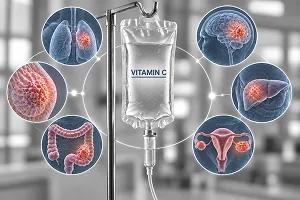
Research into high-dose IV vitamin C has expanded across several cancer types. However, the amount and quality of evidence are not equal for every cancer. Some areas have primarily laboratory or early-phase evidence, while others have progressed to randomized clinical studies. This distinction is critical when discussing potential applications.
Pancreatic Cancer
Pancreatic cancer has attracted substantial interest because laboratory research suggested that pharmacological ascorbate may create oxidative stress in pancreatic cancer cells. Early clinical studies investigated IV vitamin C with gemcitabine and demonstrated feasibility and tolerability.
More recently, a randomized study evaluated pharmacological ascorbate with gemcitabine and nab-paclitaxel in metastatic pancreatic cancer. The investigators reported longer median overall and progression-free survival in the ascorbate-containing group. Because this was a relatively small study, replication in larger trials remains important.
Ovarian Cancer
Ovarian cancer has also been examined in laboratory and early clinical research. Studies have explored whether pharmacological ascorbate could alter chemotherapy sensitivity and treatment-associated toxicity. One investigation reported findings supporting further evaluation of parenteral ascorbate alongside chemotherapy.
Prostate and Other Solid Tumors
Preclinical research has investigated pharmacological vitamin C in prostate, colorectal, liver, mesothelioma, and other cancer models. These studies provide information about potential biological mechanisms and help researchers decide which cancers may be suitable for clinical testing. However, cell-line activity should not be confused with demonstrated patient benefit.
Why Cancer Type Matters
Cancer is biologically diverse. Two cancers arising in different organs can have completely different metabolic pathways, genetic alterations, antioxidant systems, and responses to treatment. Even within one cancer type, molecular subtypes may respond differently. Consequently, researchers are increasingly interested in biomarkers that might identify tumors with particular sensitivity to pharmacological ascorbate.
Metabolic Features Under Investigation
Researchers have proposed that tumors with increased glucose transport, altered redox balance, specific mutations, or impaired antioxidant defenses might respond differently to pharmacological ascorbate. For example, recent research has investigated the relationship between dehydroascorbate uptake through glucose transport pathways and oxidative stress.
What About Breast and Lung Cancer?
Research involving other solid tumors continues, but evidence varies considerably. A laboratory observation or small early-phase study cannot establish that IV vitamin C improves survival in patients with a particular cancer. For breast, lung, colorectal, brain, and other cancers, the most appropriate interpretation is to distinguish preclinical research from clinical evidence.
Why Biomarkers Could Change the Field
One of the most interesting future directions is personalized selection. If researchers can identify measurable characteristics associated with response, IV vitamin C could potentially be studied in more precisely defined patient populations rather than treating all cancers as biologically equivalent.