
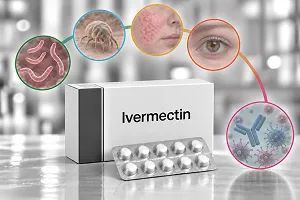
Ivermectin is a widely studied antiparasitic medicine that has played an important role in treating selected parasitic infections and supporting global public-health initiatives. Its established medical applications and continued scientific investigation make it an important subject in modern pharmacology.
Researchers have also investigated ivermectin’s effects on inflammation, cellular signaling, and cancer-related biological pathways. However, the strength of evidence differs considerably between established treatments and experimental research.
Reference: https://pubmed.ncbi.nlm.nih.gov/34430453/ →
What Is Ivermectin?
Ivermectin is an antiparasitic medicine used to treat certain infections caused by parasites. Its established uses include selected parasitic worm infections and infestations caused by particular external parasites.
Human and veterinary formulations are not interchangeable. Human treatment should involve a formulation intended for people and selected according to the relevant medical indication.
Ivermectin has also been studied for possible antiviral and anti-cancer effects, but these proposed applications require independent clinical evaluation.
Reference: https://pubmed.ncbi.nlm.nih.gov/22039800/ →
How Does Ivermectin Work?
Ivermectin acts on specific glutamate-gated chloride channels found in susceptible invertebrates. These channels help regulate nerve and muscle activity in parasites. By interfering with their normal function, ivermectin can cause paralysis and eliminate susceptible parasites.
Researchers have also explored its effects on cellular signaling, inflammation, and cell survival. However, laboratory findings do not automatically establish a useful treatment effect in humans.
Reference: https://pmc.ncbi.nlm.nih.gov/articles/PMC8354388/ →
Benefits of Ivermectin
1. Treatment of Strongyloidiasis
Strongyloidiasis is an infection caused by the parasitic roundworm Strongyloides stercoralis. It can persist for many years and may cause abdominal discomfort, diarrhea, skin problems, or serious complications in susceptible individuals.
Ivermectin is a recommended first-line treatment for uncomplicated strongyloidiasis. Diagnosis, appropriate treatment, and follow-up are important parts of medical care.
Reference: https://www.cdc.gov/ →
2. Management of Onchocerciasis
Onchocerciasis, commonly known as river blindness, is a parasitic disease transmitted through the bites of infected blackflies. It can cause severe itching, skin changes, and eye complications.
Ivermectin has an established role in controlling this disease by reducing the number of immature parasitic worms in the body. Repeated treatment may be required under public-health guidelines.
Reference: https://www.who.int/ →
3. Contribution to Lymphatic Filariasis Control
Lymphatic filariasis is a mosquito-transmitted parasitic disease that affects the lymphatic system. Long-term complications can include swelling of the limbs and chronic disability.
Ivermectin is included in certain preventive chemotherapy combinations used to control this disease. The appropriate combination depends on regional conditions and public-health recommendations.
Reference: https://www.who.int/ →
4. Treatment of Scabies
Scabies is a contagious skin infestation caused by the mite Sarcoptes scabiei. Typical symptoms include intense itching, a rash, and small burrows in the skin.
Oral ivermectin is an established treatment option for selected cases when recommended by a healthcare professional. Treatment of close contacts and appropriate environmental measures may also be necessary.
Reference: https://www.cdc.gov/ →
5. Treatment of Inflammatory Rosacea
Rosacea is a chronic skin condition that can produce facial redness, visible blood vessels, and inflammatory bumps or pustules.
Topical ivermectin cream is an established treatment option for inflammatory lesions associated with rosacea. The appropriate formulation depends on the diagnosis and should be used according to professional guidance.
Reference: https://pubmed.ncbi.nlm.nih.gov/ →
6. Contribution to Global Public Health
Ivermectin-based treatment programs have contributed to efforts to control selected parasitic diseases, particularly onchocerciasis and lymphatic filariasis.
These programs aim to reduce infection burdens and interrupt transmission through appropriate treatment coverage, monitoring, and coordinated public-health strategies.
Reference: https://pmc.ncbi.nlm.nih.gov/ →
Ivermectin and Anti-Cancer Research
Researchers have investigated ivermectin’s potential anti-cancer activity in laboratory experiments involving different cancer cell types. These studies have examined cellular growth, programmed cell death, and molecular pathways involved in cancer-cell survival.
Much of the reported anti-cancer activity comes from preclinical research, including cell-culture experiments and animal studies. These findings do not establish that ivermectin treats cancer in humans.
Reference: https://pubmed.ncbi.nlm.nih.gov/40715995/ →
How Ivermectin May Affect Cancer-Related Cellular Pathways
Preclinical studies have investigated pathways such as PI3K/Akt/mTOR and Wnt/β-catenin, which are involved in cell regulation and have relevance to several cancers.
Some laboratory experiments have reported reduced cancer-cell proliferation or increased apoptosis following ivermectin exposure. However, laboratory effects do not establish clinical effectiveness or demonstrate that the required concentrations can be safely achieved in humans.
Reference: https://pubmed.ncbi.nlm.nih.gov/40715995/ →
Ivermectin and Programmed Cell Death
Apoptosis is a natural process through which the body removes damaged or unnecessary cells. Some cancer cells develop mechanisms that allow them to avoid this process.
Certain preclinical studies have reported that ivermectin exposure can influence cell-death processes in experimental cancer models. Further research is required to determine whether these findings have clinical relevance.
Ivermectin and Cancer-Related Signaling
Cell-signaling systems regulate growth, division, and survival. Changes in these systems may contribute to cancer development and progression.
Preclinical research has explored ivermectin’s effects on signaling systems involved in cell proliferation, survival, and stress responses. The clinical significance of these findings remains uncertain.
Research Across Different Cancer Types
Researchers have investigated ivermectin in preclinical models involving breast, colorectal, lung, and other cancer types.
These studies may help scientists develop new research questions. However, experiments involving several cancer types do not demonstrate that ivermectin is an effective treatment for any cancer in humans.
What Is Needed Before Anti-Cancer Benefits Can Be Confirmed?
Potential cancer treatments require careful laboratory investigation, appropriate preclinical studies, and well-designed human clinical trials.
For ivermectin, there is insufficient high-quality clinical evidence to establish a therapeutic benefit against cancer in humans. It should not replace established oncology care or be added to a cancer-treatment plan without discussion with the treating medical team.
Reference: https://pubmed.ncbi.nlm.nih.gov/40715995/ →
Antiviral Research and Other Proposed Applications
Ivermectin has been investigated for possible antiviral effects under certain laboratory conditions. However, laboratory activity does not necessarily translate into a useful treatment in humans.
Clinical evidence has not established ivermectin as an effective treatment for COVID-19. Proposed applications must be evaluated independently according to the quality and consistency of clinical evidence.
Reference: https://pubmed.ncbi.nlm.nih.gov/38908535/ →
Ivermectin and Mitochondrial Function in Cancer Research
Mitochondria are cellular structures responsible for producing much of the energy required for normal cell function. They also participate in cellular stress responses and programmed cell death.
Preclinical researchers have investigated whether ivermectin affects mitochondrial activity and processes involved in cancer-cell survival. These findings do not establish that ivermectin selectively damages cancer cells in the human body.
Ivermectin and Oxidative Stress
Oxidative stress occurs when reactive oxygen species exceed the body’s ability to regulate them effectively. Excessive oxidative stress can damage cellular components and influence cell survival.
Some preclinical investigations have explored ivermectin’s effects on oxidative stress in experimental cancer models. These observations do not prove that ivermectin prevents cancer, treats tumors, or improves treatment outcomes in people.
Ivermectin and the Tumor Microenvironment
The tumor microenvironment includes the cells, blood vessels, immune cells, and surrounding tissues that interact with a tumor.
Researchers study these interactions to understand cancer growth and treatment response. The extent to which ivermectin affects the tumor microenvironment in clinically meaningful ways remains uncertain.
Ivermectin and the Immune System: A Research Perspective
The immune system plays an important role in identifying abnormal cells and regulating biological responses. Some experimental studies have explored ivermectin’s effects on inflammatory and immune-related signaling pathways.
An effect on an immune-related pathway does not automatically mean that a medicine strengthens anti-cancer immunity. Further research is required to determine whether ivermectin has clinically meaningful effects on immune responses in people with cancer.
Could Ivermectin Be Studied in Combination With Other Cancer Treatments?
Researchers sometimes investigate whether medicines have complementary effects when used together. Such investigations require carefully controlled laboratory studies and, when justified, clinical trials.
Laboratory findings cannot establish that combining ivermectin with chemotherapy, targeted therapy, immunotherapy, or radiation is beneficial or safe. Patients should consult their oncology team before adding any medicine or supplement to an existing treatment plan.
Why Drug Repurposing Is Important in Medical Research
Drug repurposing involves investigating whether an existing medicine may have a useful application beyond its original approved indication.
Ivermectin’s established antiparasitic activity and its reported effects in preclinical studies have made it a subject of drug-repurposing research. However, investigating a new application does not prove that the medicine is effective for that condition.
Understanding the Difference Between Laboratory and Clinical Evidence
Laboratory experiments help researchers identify possible biological effects. Animal studies can provide additional information about how a compound behaves in a living organism.
Human clinical trials are required to evaluate safety, appropriate dosing, and meaningful benefits for patients. A reduction in cancer-cell growth in a laboratory experiment does not demonstrate tumor shrinkage, longer survival, or improved quality of life in humans.
Reference: https://www.cancer.gov/ →
The Future of Ivermectin Research
Future research may continue to investigate ivermectin’s molecular effects, interactions with cellular signaling systems, and potential applications in drug development.
For cancer-related applications, further studies must determine whether laboratory findings translate into safe and meaningful benefits in humans. Well-designed clinical trials are essential before ivermectin can be recommended as an anti-cancer treatment.
Conclusion
Ivermectin has established medical uses for selected parasitic infections and certain recognized dermatological indications. Its possible anti-cancer effects remain an area of scientific investigation rather than an established cancer treatment.
Understanding the difference between established medical uses and experimental findings is essential for responsible health communication. Patients should seek professional medical advice for diagnosis and treatment decisions.
Additional research resource: https://clinicaltrials.gov/ →