
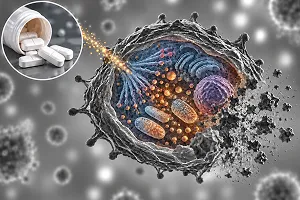
Exploring the Proposed Biological Mechanisms
Fenbendazole has attracted interest in cancer research because laboratory studies suggest that it may influence several biological processes involved in how cancer cells grow, produce energy, respond to cellular stress, and survive. Researchers have investigated several possible mechanisms, including effects on microtubules, glucose metabolism, oxidative stress, mitochondrial function, and cell-death pathways.
1. Effects on Microtubules
Microtubules are tiny structures inside cells that help maintain cell shape, transport cellular components, and organize cell division. Because rapidly dividing cells depend heavily on properly functioning microtubules, this system is an important target in cancer research.
Fenbendazole belongs to the benzimidazole family, whose antiparasitic activity involves disruption of parasite microtubules. Researchers have therefore investigated whether fenbendazole might also interfere with microtubule-related processes in cancer cells. Experimental findings provide a biological basis for further investigation, but the effects observed in laboratory systems do not establish that fenbendazole produces the same anticancer effects in patients.
2. Cellular Metabolism and Energy Production
Cancer cells can alter the way they obtain and use energy to support continuous growth. This altered metabolism is an important area of cancer biology. Laboratory research has explored whether fenbendazole can affect metabolic processes in cancer cells, including pathways involved in energy production.
Researchers have reported changes in cellular metabolism under experimental conditions, raising questions about whether metabolic disruption could contribute to the compound’s observed effects. However, cancer metabolism is highly complex, and an effect on cellular metabolism in a laboratory model does not automatically translate into therapeutic activity in humans.
3. Glucose Utilization
Glucose is an important energy source for cells. Many cancer cells show altered glucose uptake and glucose metabolism compared with normal cells. Some experimental studies have investigated whether fenbendazole can interfere with glucose utilization in cancer cells.
Changes in glucose availability or processing could potentially place additional stress on cells that depend heavily on metabolic activity. This is one of the mechanisms that has contributed to interest in fenbendazole research, but it remains an experimental finding rather than an established clinical mechanism.
4. Oxidative Stress
Cells continuously produce reactive oxygen species as part of normal metabolism. They also have antioxidant systems that help maintain balance. Research has investigated whether fenbendazole can alter this balance and increase oxidative stress under experimental conditions.
Excessive oxidative stress can damage cellular components and may influence signaling pathways involved in cell survival and death. The relationship between oxidative stress and cancer is complex, however. More oxidative stress is not necessarily better or worse in every cancer context, and the biological effects can depend on the type of cell and experimental conditions. [PubMed]
5. Mitochondrial Function
Mitochondria are often described as the cell’s energy-producing structures, but they also participate in cellular signaling and programmed cell death. Experimental research has examined whether fenbendazole can influence mitochondrial activity in cancer cells.
Changes in mitochondrial function may contribute to metabolic stress and can potentially interact with pathways involved in cell survival. Researchers continue to investigate whether these mitochondrial effects are central to fenbendazole’s biological activity or are secondary consequences of other cellular changes.
6. Cell-Death Pathways
Cells have built-in mechanisms that regulate their survival and removal. One important process is apoptosis, a controlled form of cell death. Laboratory studies have reported that fenbendazole can be associated with changes in pathways linked to cancer-cell survival and cell death.
Researchers are investigating whether disruption of microtubules, metabolism, oxidative balance, and mitochondrial function may contribute to these effects. Importantly, observing cell death in cultured cancer cells does not mean that the same process will selectively eliminate tumors in a person. Cancer cells and healthy cells exist within a much more complicated biological environment in the human body.
How Could These Mechanisms Be Connected?
These mechanisms should not necessarily be viewed as separate events. Cellular systems are interconnected. Changes in microtubule function may affect cell division; metabolic changes can influence mitochondrial activity; altered mitochondrial function can affect oxidative stress; and cellular stress can influence pathways involved in cell survival and death.
This interconnected biology is one reason fenbendazole remains an interesting subject for experimental research. Researchers are trying to determine which effects are most important, whether they occur at achievable concentrations, and whether they can ultimately produce meaningful effects in humans.