
Introduction
Vitamin C, also known as ascorbic acid or ascorbate, is an essential nutrient involved in antioxidant defense, collagen formation, cellular metabolism, and several enzymatic reactions. While ordinary dietary vitamin C is primarily discussed as a nutritional compound, intravenous administration can produce blood concentrations that are far higher than those achievable through oral supplementation.
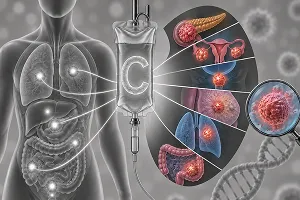
This pharmacological difference has led researchers to investigate whether high-dose intravenous vitamin C could have a role in cancer care.
Source: National Cancer Institute – Vitamin C and Cancer →
Why the Route of Administration Matters
The distinction between oral and intravenous vitamin C is central to understanding the research. Oral vitamin C absorption is limited by intestinal transport and renal excretion. IV administration bypasses intestinal absorption and can produce millimolar concentrations in plasma.
At these pharmacological concentrations, vitamin C can behave differently from its usual physiological antioxidant role, including participating in reactions that generate hydrogen peroxide under certain experimental conditions.
Source: PubMed – Pharmacological Ascorbate and Cancer Research →
This pharmacokinetic difference explains why studies of IV vitamin C should not automatically be interpreted using evidence from ordinary dietary vitamin C or standard oral supplements. Researchers are investigating IV vitamin C as a pharmacological intervention rather than simply as nutritional replacement.
Early phase I studies demonstrated that high-dose IV ascorbate could achieve very high plasma concentrations and was generally tolerated in carefully selected patients.
Source: PubMed – Phase I Study of Intravenous Ascorbic Acid →
What Early Clinical Studies Found
Early clinical investigations primarily focused on safety, pharmacokinetics, and determining whether pharmacological concentrations could be achieved in people with cancer.
One phase I study evaluated escalating doses of IV ascorbic acid in patients with advanced malignancies. Although the treatment was well tolerated, no objective anticancer responses were observed in that particular study.
This illustrates an important point: biological plausibility and tolerability do not automatically establish clinical effectiveness.
Source: PubMed – Phase I Clinical Study →
Another phase I investigation evaluated high-dose IV ascorbic acid in patients with advanced solid tumors. Doses up to 70–110 g/m² produced prolonged high plasma concentrations, and the treatment was reported to be well tolerated.
However, the study was primarily designed to evaluate pharmacokinetics and safety rather than prove tumor-control benefit.
Source: PubMed – High-Dose Intravenous Ascorbate Study →
Evidence From Clinical Reviews
Systematic reviews have found that the clinical literature includes phase I and II studies, observational research, case reports, and a smaller number of randomized trials.
A systematic review published in Antioxidants evaluated clinical trials of intravenous ascorbate and concluded that the available evidence supported a generally favorable safety profile but that the evidence for clinical effectiveness remained limited.
Source: PubMed – Systematic Review of Intravenous Ascorbate →
An earlier systematic review identified 37 studies involving IV vitamin C and reported that the available evidence was preliminary. Some studies suggested possible improvements in quality of life or potential anticancer effects when IV vitamin C was combined with chemotherapy, but the authors emphasized that more rigorous clinical evidence was needed.
Source: PubMed – Systematic Review of Intravenous Vitamin C →
Newer Evidence
More recent research has begun examining IV vitamin C using more controlled designs.
For example, a randomized clinical trial in metastatic pancreatic cancer evaluated pharmacological ascorbate alongside gemcitabine and nab-paclitaxel. The study reported longer median overall and progression-free survival in the ascorbate-containing group.
However, this was a relatively small trial, involving 34 participants, so its results need confirmation in larger, independently conducted studies.
Source: PubMed – Randomized Clinical Trial in Metastatic Pancreatic Cancer →
A 2025 systematic review and meta-analysis evaluated eight studies involving 2,722 adults with malignant disease. The analysis reported an association between IV vitamin C and longer overall survival, while progression-free survival showed a positive but statistically uncertain trend.
Importantly, the included studies differed in design, dose, cancer populations, and treatment combinations, so these results should be interpreted as evidence supporting further investigation rather than definitive proof of benefit for every cancer type.
Source: PubMed – 2025 Systematic Review and Meta-Analysis →
What Can We Say With Confidence?
The current evidence supports several cautious conclusions.
First, IV administration can achieve pharmacological vitamin C concentrations that oral administration generally cannot.
Second, IV vitamin C has been studied in multiple cancer settings and has generally been tolerated in clinical trials.
Third, some clinical studies have reported encouraging outcomes, particularly when IV vitamin C is investigated alongside conventional therapy.
Finally, evidence remains insufficient to establish IV vitamin C as a replacement for established cancer treatments.