
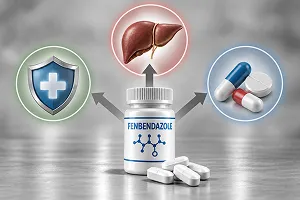
Safety is an essential part of evaluating any potential repurposed medicine. Fenbendazole has been used as a veterinary antiparasitic for many years, which means researchers have accumulated substantial experience with the compound in animals. This established background is one reason scientists can investigate fenbendazole further as a possible repurposed drug. However, veterinary experience provides a starting point for research rather than automatically establishing the same safety profile in humans.
Fenbendazole: A Well-Studied Veterinary Compound
Fenbendazole belongs to the benzimidazole class of antiparasitic compounds and has been used in veterinary medicine against several parasitic infections. Its relatively established veterinary history gives researchers information about its chemical properties, pharmacology, metabolism and biological activity. This existing knowledge can be valuable when considering whether a compound deserves further investigation for a completely different medical application such as oncology.
Why Its Safety Profile Is Interesting to Researchers
One positive aspect of fenbendazole research is that safety and toxicity have already been investigated in experimental animals. Researchers have been able to study absorption, distribution, metabolism and elimination, helping provide a foundation for understanding how the compound behaves biologically. These studies can guide future research into formulations and delivery methods that may improve how consistently fenbendazole reaches the body.
The 2024 review of fenbendazole specifically discussed its pharmacokinetics, toxicity profile and possible approaches for improving bioavailability. This makes safety research part of the broader drug-repurposing pathway rather than simply an afterthought.
Human Safety Research Is an Important Next Step
A major opportunity for future research is establishing a detailed human safety profile. Fenbendazole is not currently approved for human use, so information about its human pharmacokinetics, appropriate exposure levels, long-term tolerance and potential interactions remains limited. Proper clinical studies could provide much more reliable information than isolated reports or informal experiences.
This is an important direction for the field: researchers have clearly defined questions that can be investigated through controlled studies, including how fenbendazole is absorbed in humans, how it is metabolized, and what exposure levels can be achieved safely.
Reported Adverse Effects Help Guide Safer Research
Published human case reports have identified liver injury as an important safety issue that deserves further investigation. For example, a 2024 case report described severe drug-induced liver injury following self-administration of veterinary fenbendazole, with liver function returning toward normal after discontinuation. More recent reports have also described fenbendazole-associated liver injury.
Although individual case reports cannot determine how frequently an adverse effect occurs, they are valuable scientifically because they identify potential risks that future clinical trials can monitor carefully.
2024 case report | More recent report →
Why Medical Supervision Matters
The positive lesson from these reports is that safety can be approached systematically. If fenbendazole is studied in properly designed clinical research, investigators can establish appropriate monitoring procedures, evaluate liver function, document other medications and identify possible drug interactions.
This type of structured monitoring can provide much stronger safety information than unsupervised use. Cancer patients may also receive chemotherapy, immunotherapy, targeted therapy or other medicines, making it particularly important to understand whether fenbendazole could influence other treatments.
Veterinary Use Provides a Research Foundation—Not a Human Dose
The long history of veterinary use is useful because researchers are not starting with a completely unknown compound. Nevertheless, animals and humans can process medicines differently. Differences in metabolism, absorption, body size, formulation and concurrent medications can change both effectiveness and toxicity.
Therefore, veterinary experience can support further investigation while human clinical studies remain necessary to determine whether fenbendazole can be used safely and appropriately in people.
The Positive Research Opportunity
One encouraging aspect of fenbendazole safety research is the opportunity to improve our understanding through modern drug-development methods. Researchers can investigate optimized formulations, controlled exposure, pharmacokinetics, drug interactions and biomarkers of toxicity.
The 2024 review specifically discussed approaches that could potentially improve bioavailability while reducing unwanted toxicity. This means future research does not have to rely simply on the way veterinary fenbendazole is currently formulated. Pharmaceutical researchers can investigate whether alternative formulations or delivery systems could produce more predictable exposure.