
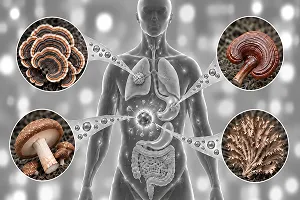
Why Species, Preparation, Cancer Type, and Clinical Evidence Matter
Medicinal mushrooms should not be viewed as one single therapy. Different mushroom species contain different combinations of biologically active compounds, and researchers have investigated them in different cancer settings.
Among the available human research, some of the most extensive evidence involves Turkey Tail-derived preparations such as PSK and PSP, while evidence for several other medicinal mushrooms remains more preliminary.
This distinction is important because evidence from one mushroom preparation cannot automatically be applied to every mushroom supplement.
Turkey Tail — Gastric, Colorectal & Lung Cancer
Turkey Tail (Trametes versicolor) is one of the more extensively studied medicinal mushrooms in oncology. Its preparation PSK (polysaccharide-K) has been investigated alongside conventional cancer treatment, including research involving gastric, colorectal, and lung cancers.
Clinical studies have reported potential effects involving survival, immune function, and treatment-related outcomes. However, the certainty of evidence varies according to the cancer type, preparation, study design, and outcome being measured.
Therefore, research involving a specific PSK preparation should not automatically be interpreted as evidence for all Turkey Tail products or all medicinal mushrooms.
Source: National Cancer Institute — Medicinal Mushrooms →
Reishi — Multiple Cancer Research Areas
Reishi (Ganoderma lucidum) has attracted scientific interest because of its immunomodulatory properties and various biologically active compounds.
Research has explored potential effects in cancer settings including lung, breast, colorectal, and prostate cancer. However, much of the evidence remains at the laboratory, animal, or early clinical-research stage.
These findings may help researchers understand possible mechanisms, but they do not establish Reishi as a proven anticancer treatment. The available human evidence also varies considerably between preparations and clinical settings.
Source: PubMed — Systematic Review of Medicinal Mushrooms and Cancer →
Shiitake & Maitake — Immune and Supportive-Care Research
Shiitake (Lentinula edodes) and Maitake (Grifola frondosa) contain polysaccharides and β-glucans that have attracted interest for their potential interactions with the immune system.
Researchers have explored these mushrooms in different cancer-related settings, including their possible effects on immune responses and supportive-care outcomes.
However, the clinical evidence for these mushrooms is considerably less established than the evidence surrounding some specific PSK studies. More rigorous human research is needed to determine whether these biological effects translate into meaningful clinical benefits.
Source: PubMed — Systematic Review of Medicinal Mushrooms and Cancer→
Cancer-Specific Research Matters
Medicinal mushrooms have been investigated across a range of cancer types, including gastric, colorectal, breast, lung, liver, and other cancers. However, results cannot simply be transferred from one cancer type to another.
A 2023 systematic review identified 39 clinical studies involving 12 different mushroom preparations. The researchers found potentially interesting findings across several outcomes but concluded that the available evidence remained insufficient to recommend routine mushroom supplementation as part of cancer care.
This demonstrates why the specific mushroom, preparation, cancer type, treatment setting, and quality of evidence all matter.
Source: PubMed — Systematic Review of Medicinal Mushrooms and Cancer →
Medicinal Mushrooms in Oncology: Safety, Interactions & Evidence
What Patients Should Know Before Using Medicinal Mushrooms
Medicinal mushrooms are often described as “natural,” but natural does not automatically mean risk-free. Safety can depend on the mushroom species, preparation, dose, individual health circumstances, and whether the product is being used alongside conventional medicines.
The National Cancer Institute notes that medicinal-mushroom products have generally been well tolerated in some clinical studies, but safety evidence can vary considerably between different products and preparations.
Possible Side Effects
Clinical studies of medicinal mushrooms have generally reported relatively few serious adverse effects, although some preparations may cause mild problems such as:
- Nausea
- Diarrhea
- Digestive discomfort
- Stomach upset
Reishi (Ganoderma lucidum), for example, has been studied in clinical settings and is generally considered reasonably well tolerated in the available research. However, individual responses can differ, and tolerability of one mushroom preparation does not necessarily predict the safety of another.
Source: National Cancer Institute — Medicinal Mushrooms →
Potential Drug Interactions
One of the most important considerations for people receiving cancer treatment is the possibility of mushroom drug interactions.
Certain mushroom-derived compounds may potentially influence:
- Drug-metabolizing enzymes
- Drug transport proteins
- Immune signaling pathways
- Blood-clotting mechanisms
A systematic review examining Reishi (Lingzhi) and Turkey Tail (Yunzhi) identified evidence suggesting potential pharmacokinetic and pharmacodynamic interactions with some cytotoxic medicines. However, the researchers also emphasized that much of the available evidence was limited in quality, meaning the clinical importance of many proposed interactions remains uncertain.
Source: Systematic Review — Medicinal Mushroom–Drug Interactions →
Why Cancer Patients Need Extra Caution
Cancer treatments can involve medicines where relatively small changes in drug exposure may affect either treatment effectiveness or toxicity. Changes in drug absorption, metabolism, or elimination can therefore be clinically important in some situations.
This is why the National Cancer Institute recommends discussing dietary supplements and complementary products with the oncology team before using them alongside anticancer medicines.
This is particularly relevant for people receiving chemotherapy, targeted therapy, immunotherapy, radiation treatment, or multiple medications simultaneously.
Source: National Cancer Institute — Dietary and Drug Interactions →
Product Quality Matters
Safety is not determined only by the mushroom species. Different commercial products can vary in:
- Species identification
- Extraction method
- Concentration of compounds
- Standardization
- Additional ingredients
- Manufacturing quality
The amount and composition of biologically active compounds can therefore differ substantially between products.
The National Cancer Institute also notes that dietary supplements are regulated differently from approved drugs, and the ingredients and quantities present in supplements may vary.
For this reason, research performed using one standardized mushroom preparation should not automatically be assumed to apply to every commercially available mushroom supplement.
Source: National Cancer Institute — Dietary and Drug Interactions →
The Clinical Perspective
The safest scientific way to view medicinal mushrooms in oncology is as an area of complementary-medicine research, rather than assuming that they are automatically safe cancer treatments.
Before combining a mushroom extract or supplement with:
- Chemotherapy
- Immunotherapy
- Targeted therapy
- Radiation therapy
- Anticoagulants or antiplatelet medicines
- Other prescription medicines
the specific product, ingredients, dose, and treatment combination should be reviewed with the treating healthcare professional.
This is especially important because evidence from laboratory or animal studies cannot reliably predict the safety of every mushroom product when combined with a patient’s individual medications.
Source: National Cancer Institute — Dietary and Drug Interactions →