
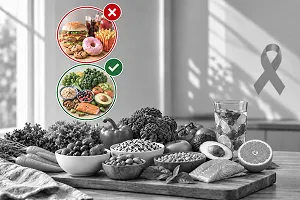
Introduction: Can Food Really Influence Cancer?
Nutrition and cancer are closely connected but not in the simple way that social media sometimes suggests. You may have heard statements such as “sugar feeds cancer,” “a ketogenic diet starves tumours,” “fasting kills cancer cells,” or “this superfood prevents cancer.”
Some of these ideas are based on real biological observations. Others come from early laboratory experiments that have been interpreted far beyond what the human evidence can actually prove.
The reality is more interesting. Food can influence body weight, metabolism, hormones, inflammation, the gut microbiome and nutritional status. These factors can interact with pathways involved in cancer development and cancer treatment.
However, nutrition is only one part of a much larger picture that includes genetics, age, environmental exposures, infections, hormones, immune function, physical activity and chance.
Example: Eating vegetables every day does not create an invisible shield around the body that prevents cancer. Instead, a diet rich in vegetables may contribute to a healthier overall dietary pattern, better fibre intake and healthier body weight factors that can collectively influence long-term health.
Research from large cancer organisations therefore focuses much more on overall dietary patterns and lifestyle than on individual “cancer-fighting” foods.
1. The First Principle: There Is No Single “Cancer Diet”
Cancer is not one disease. Breast cancer, colorectal cancer, lung cancer, prostate cancer, pancreatic cancer and blood cancers have different biological characteristics.
This means that a diet studied in one cancer population cannot automatically be assumed to work in another.
Nutrition research is also difficult because people eat combinations of foods rather than isolated nutrients. Someone who eats more vegetables may also exercise more, smoke less, drink less alcohol and have a different body-weight profile.
Example: Imagine two people who both eat tomatoes every day. One person also exercises regularly and eats mostly whole foods, while the other consumes large amounts of processed meat, sugary drinks and alcohol. It would be misleading to attribute their overall cancer risk simply to tomato consumption.
This is why researchers increasingly examine dietary patterns rather than searching for one magical food.
A large systematic review involving more than three million participants found associations between greater adherence to Mediterranean-style dietary patterns and lower risks of several cancers, although much of this evidence comes from observational research and therefore cannot prove that the diet itself caused the lower risk.
2. Fibre: One of the Most Studied Components of the Diet
Dietary fibre is found in foods such as beans, lentils, vegetables, fruits, wholegrains, nuts and seeds.
Unlike many nutrients, some forms of fibre reach the large intestine, where gut microorganisms can ferment them and produce compounds such as short-chain fatty acids. This has attracted considerable interest in colorectal cancer research.
A systematic review and meta-analysis examining dietary fibre and colon cancer found that higher fibre intake was associated with a lower risk of colon cancer.
However, an association observed across populations does not prove that fibre alone prevents cancer in every individual. That approach increases fibre while also providing many other nutrients.
3. Fruits and Vegetables: More Than Vitamins
Fruits and vegetables contain fibre, vitamins, minerals and thousands of naturally occurring plant compounds.
Scientists have investigated compounds such as carotenoids, flavonoids and polyphenols because laboratory experiments suggest that some can influence oxidative stress, inflammation and cell-signalling pathways.
But laboratory research needs careful interpretation. This is an important distinction between mechanistic evidence and clinical evidence.
Eating a wide variety of fruits and vegetables remains a sensible component of a healthy dietary pattern, but individual foods should not be presented as cancer treatments.
4. Wholegrains and Legumes: Everyday Foods With Scientific Interest
Wholegrains include foods such as oats, brown rice and whole-wheat products. Legumes include lentils, chickpeas, beans and peas.
These foods provide fibre, plant protein and a variety of micronutrients. Their potential relevance to cancer is not necessarily due to one magical molecule. Instead, they can contribute to a broader dietary pattern that supports metabolic health and adequate fibre intake.
Example: Replacing some highly refined carbohydrate foods with oats at breakfast, brown rice at lunch or lentils with dinner is a dietary change that can improve overall food quality without requiring an extreme diet.
The WCRF specifically recommends making wholegrains, vegetables, fruits and legumes an important part of the usual diet.
5. Red Meat and Processed Meat: Why the Difference Matters
Not all meat products are biologically identical. Processed meats include products that have undergone processes such as curing, salting, fermentation or smoking.
Research has particularly linked processed meat consumption with colorectal cancer.
The International Agency for Research on Cancer classified processed meat as carcinogenic to humans and red meat as probably carcinogenic to humans, based on the available evidence.
This classification describes the evidence that an exposure can cause cancer; it does not mean that every person who eats processed meat will develop cancer.
The WCRF recommends limiting red meat and eating little, if any, processed meat.
6. Ultra-Processed Foods: A Growing Area of Research
Ultra-processed foods have become a major area of nutrition research.
These foods can include industrially formulated products containing combinations of refined ingredients, additives, flavourings and other components. Some are high in calories, salt, sugar or unhealthy fats.
Large observational studies have reported associations between higher consumption of ultra-processed foods and several adverse health outcomes.
However, it is important not to turn the category into a simplistic “poison” label. Not every processed food has the same nutritional profile, and observational research can be affected by other lifestyle factors.
The broader goal is to make minimally processed and nutrient-rich foods the foundation of the diet while reducing frequent consumption of highly processed, calorie-dense foods.
7. Mediterranean-Style Diet: Why Researchers Keep Studying It
The Mediterranean dietary pattern generally emphasises vegetables, fruits, wholegrains, legumes, nuts, seeds, olive oil and fish, while limiting processed meat and other less nutrient-dense foods.
It has attracted extensive research because it is not based on one nutrient. Instead, it represents a complete pattern of eating.
A recent systematic review and meta-analysis published in 2026 examined 126 studies involving more than eight million participants and reported associations between greater adherence to a Mediterranean diet and lower risks of several cancer types.
The authors also noted that the certainty of evidence varied across outcomes.
A Mediterranean-style approach does not require someone to eat imported foods or follow a rigid menu. In an Indian context, the principle could translate into vegetables, fruits, pulses, wholegrains, nuts and seeds, with appropriate protein sources and less processed meat and highly processed food.
8. Soy and Breast Cancer: Why the Story Is More Nuanced Than “Soy = Estrogen”
Soy is sometimes avoided because it contains isoflavones, plant compounds with estrogen-like activity.
However, biological activity does not automatically mean that eating normal amounts of soy increases breast cancer risk.
Research has examined soy foods and breast cancer outcomes, including survival and recurrence.
A systematic review and meta-analysis involving more than 37,000 women with breast cancer found some associations between soy/isoflavone consumption and outcomes, but the authors described the evidence as limited and not conclusive for every outcome.
Foods such as tofu, tempeh, edamame and traditional soy foods are examples of soy foods and should not automatically be treated as equivalent to high-dose concentrated isoflavone supplements.
The evidence for whole soy foods is different from the question of using concentrated supplements.
9. Dairy Foods: Another Example of Why Nutrition Is Not Black and White
Dairy products are sometimes promoted as harmful and sometimes promoted as protective. The actual evidence is more complicated.
Several observational studies have investigated dairy consumption and colorectal cancer.
A meta-analysis of cohort studies found an association between higher total dairy and milk consumption and lower colorectal cancer risk.
However, observational findings cannot establish that dairy itself prevents colorectal cancer.
If someone consumes yoghurt as part of a healthy diet, there is no scientific reason to assume that the yoghurt itself is a cancer treatment.
At the same time, there is also no basis for automatically eliminating all dairy products solely because of cancer fears. Individual tolerance, nutritional needs and medical circumstances should be considered.
10. Sugar and Cancer: Does Sugar “Feed” Tumours?
This is one of the most misunderstood subjects in cancer nutrition.
Cancer cells can use glucose for energy. But normal cells also need glucose. The body has sophisticated systems for maintaining blood glucose.
Even if someone dramatically reduces dietary sugar, the body can produce glucose from other sources. Therefore, removing sugar from the diet has not been established as a treatment that starves cancer.
However, reducing excessive added sugar can still be useful for overall health.
Replacing sugary soft drinks with water does not “starve a tumour.” It simply reduces excess sugar and calories, which may help with overall dietary quality and weight management.
This is a good example of why a healthy nutritional recommendation can exist without turning it into a cancer cure claim.
11. The Ketogenic Diet: A Fascinating Theory Still Under Investigation
The ketogenic diet is very low in carbohydrates, relatively high in fat and contains moderate amounts of protein. It shifts metabolism toward greater production and use of ketone bodies.
Interest in cancer began partly because cancer cells often display altered glucose metabolism.
This created a compelling hypothesis: Could reducing carbohydrate availability make cancer cells more vulnerable while normal cells adapt to ketones?
The theory is biologically interesting but the human evidence is not yet strong enough to make the ketogenic diet a general cancer treatment.
A 2021 systematic review examined 39 studies involving 770 cancer patients and concluded that there was no conclusive evidence for anti-tumour effects or improved overall survival.
The studies were heterogeneous, often small and frequently had methodological limitations.
More recent research continues to investigate the question. A 2024 systematic review and meta-analysis restricted to randomised controlled trials found that ketogenic diets lowered glucose levels but did not establish definitive improvements in several cancer-related outcomes.
12. Ketogenic Diet: Potential Benefits and Potential Problems
Ketogenic diets may produce weight loss and changes in metabolic markers in some people. However, weight loss is not automatically beneficial for someone with cancer.
A patient who is overweight may have a very different nutritional situation from a patient already experiencing muscle loss or cancer-related wasting.
A systematic review of ketogenic diets in cancer patients found significant weight loss in many studies and reported that adherence was often difficult.
Example: Losing excess body fat may be useful in one clinical situation, while losing muscle and nutritional reserves during chemotherapy may be harmful in another.
Therefore, a ketogenic diet should not be treated as a universal cancer diet.
If considered during cancer treatment, it should be discussed with the oncology team and an appropriately trained nutrition professional.
13. Fasting During Cancer Treatment: Interesting Science, Limited Human Evidence
Fasting has become another highly discussed topic.
Preclinical studies have suggested that short periods of fasting may alter metabolism and potentially affect how normal and cancer cells respond to stress.
This led researchers to investigate whether fasting around chemotherapy could reduce treatment-related side effects or improve treatment response.
But the human evidence remains limited.
A systematic review of fasting during cancer treatment identified only eight studies involving 379 patients. The researchers concluded that clinical evidence was still limited and that larger, better-designed studies were needed.
A person might read that “fasting protects healthy cells while making cancer cells weaker.” That may describe a biological hypothesis from laboratory research, but it does not mean that every patient should fast before chemotherapy.
Cancer treatment can increase nutritional demands, and some patients are already vulnerable to weight loss and muscle wasting.
14. Intermittent Fasting and Time-Restricted Eating
Intermittent fasting includes different approaches, while time-restricted eating generally limits daily eating to a specific window.
Researchers are studying whether changing when people eat can influence insulin, glucose, circadian biology, body weight and other metabolic pathways.
A systematic review published in 2025 evaluated clinical evidence for time-restricted eating in people with cancer and found that human research was still developing.
A healthy person might choose to eat within a consistent daily window for lifestyle reasons. That is very different from a cancer patient undergoing chemotherapy who may need frequent meals or snacks because of nausea, poor appetite or increased nutritional needs.
Therefore, the timing of food should not be separated from the patient’s overall nutritional condition.
15. Fasting-Mimicking Diets: Another Emerging Approach
Researchers have also developed fasting-mimicking diets, which aim to produce some metabolic effects associated with fasting while still providing limited calories and nutrients.
This is scientifically interesting because complete fasting can be difficult and potentially unsafe for some patients.
Research is exploring whether these approaches can influence treatment response, metabolism and quality of life.
However, this remains an emerging field.
A 2026 scoping review identified 20 interventional studies involving 871 cancer patients or survivors across fasting-based approaches such as time-restricted eating, intermittent fasting, short-term fasting and fasting-mimicking diets.
The increasing number of studies is encouraging for research but it also shows why this field should not yet be reduced to a simple “fasting cures cancer” message.
16. Vitamin D: Important Nutrient, Complicated Cancer Evidence
Vitamin D is essential for normal biological functions, including bone health and calcium regulation.
Researchers have also investigated its possible relationship with cancer. However, vitamin D status and vitamin D supplementation are not the same question.
Randomised trials have produced mixed results.
A large individual-patient-data meta-analysis of 14 randomised trials involving more than 104,000 participants found that vitamin D3 supplementation did not significantly reduce cancer mortality in the primary analysis, although some analyses of daily dosing suggested a possible reduction.
17. Supplements: When “More” Does Not Mean “Better”
Cancer patients are often offered supplements containing vitamins, minerals, herbs, antioxidants or concentrated plant compounds.
The important question is not simply whether a substance is “natural.” The questions are:
- Is there evidence that the person is deficient?
- Does the supplement improve a meaningful clinical outcome?
- Could it interact with treatment?
- Is the dose safe?
- Has it actually been studied in cancer patients?
A patient with a documented nutritional deficiency may benefit from appropriate supplementation.
Another person taking very high doses of multiple supplements without medical guidance may gain no cancer benefit and could potentially create additional problems.
Major cancer-prevention recommendations generally favour obtaining nutrients through food rather than relying on supplements for cancer prevention.
18. Omega-3 Fatty Acids: Promising Biology, Important Questions
Omega-3 fatty acids are found in foods such as fatty fish, and some are available as supplements.
Researchers have investigated their potential effects on inflammation, cardiovascular health, body composition and cancer-related outcomes.
But promising mechanisms do not automatically translate into improved cancer survival.
A fish-rich dietary pattern may provide protein, omega-3 fatty acids, vitamins and minerals. That is very different from assuming that a concentrated omega-3 capsule will directly attack a tumour.
As with many nutritional interventions, researchers continue to distinguish between nutritional adequacy, general health benefits and specific anti-cancer effects.
19. The Gut Microbiome: The Hidden Ecosystem Inside Us
The digestive tract contains a huge community of microorganisms known collectively as the gut microbiome. Diet can influence this ecosystem.
Fibre-rich foods can provide substrates for certain bacteria, which can produce metabolites that interact with intestinal cells and immune pathways.
Scientists are now investigating whether the microbiome may influence cancer development and even responses to some cancer therapies.
Eating a variety of plant foods does not “detox the microbiome overnight.” Instead, regular dietary patterns can influence the nutrients available to intestinal microbes over time.
This is one of the most promising areas of nutrition science but researchers are still determining which microbial changes are causes, consequences or simply markers of disease.
20. Nutrition During Chemotherapy: Sometimes the Goal Is Different
Cancer treatment can completely change nutritional priorities.
Chemotherapy, radiation therapy, surgery and other treatments can cause nausea, vomiting, diarrhoea, constipation, mouth sores, taste changes and loss of appetite.
Some patients lose weight and muscle rapidly.
In such situations, the goal may not be weight loss or carbohydrate restriction. It may be maintaining energy intake, protein intake, hydration and muscle mass.
Example: If a patient is struggling to eat after chemotherapy, a high-protein meal replacement or nutrient-dense food may be more useful than forcing a restrictive “anti-cancer diet.”
Clinical nutrition guidelines recommend early nutritional assessment and appropriate nutritional support for people with cancer.
21. Protein and Muscle: An Underappreciated Part of Cancer Nutrition
Cancer-related weight loss can involve both fat and muscle.
Muscle is important for mobility, strength and physical function.
Losing substantial muscle can make treatment and recovery more difficult.
This is why cancer nutrition is not simply about counting calories.
Nutrition professionals may therefore focus on adequate protein, energy intake and appropriate physical activity according to the individual’s condition.
22. What About “Detox” Diets?
The word “detox” is popular, but the human body already has sophisticated systems for processing and eliminating many substances, involving organs such as the liver and kidneys.
Juice-only diets, prolonged fasting or highly restrictive cleanses have not been established as cancer treatments.
Example: Drinking only vegetable juice for several days may sound scientifically attractive because it feels “clean,” but it may provide inadequate protein, calories or other nutrients, particularly problematic for someone already experiencing cancer-related weight loss.
A healthier approach is usually to improve the quality and variety of the overall diet rather than attempting an extreme nutritional reset.