
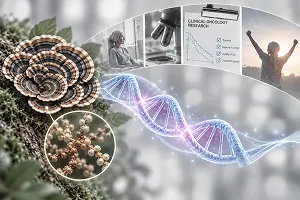
Research on medicinal mushrooms continues to expand, but the clinical evidence remains considerably smaller than the laboratory literature. Researchers continue to investigate mushrooms such as Ganoderma lucidum (Reishi), Trametes versicolor (Turkey Tail), Lentinula edodes (Shiitake), Grifola frondosa (Maitake), and Trametes robiniophila (Huaier).
A 2023 systematic review identified 39 clinical studies involving 12 different mushroom preparations, but concluded that the available evidence was still insufficient to recommend routine mushroom supplementation for people with cancer.
View the 2023 systematic review on PubMed →
2025 Review: Where Does the Field Stand?
A 2025 review examined research involving mushroom-derived compounds, including β-glucans, polysaccharides, triterpenoids, and protein-polysaccharide complexes. The review described anticancer effects reported in laboratory and animal models, including effects on cellular pathways and tumor-related biological processes.
However, the authors emphasized that most of the available evidence remains preclinical. Additional research, including toxicology, pharmacokinetic studies, and well-designed clinical trials, is needed before these findings can be confidently translated into cancer treatment.
This highlights an important principle: promising laboratory findings can identify potential therapeutic candidates, but they do not by themselves establish clinical effectiveness.
View the 2025 review on PubMed →
Reishi: Newer Human Evidence
A 2025 systematic review and meta-analysis evaluated 17 randomized controlled trials involving 971 participants receiving Ganoderma lucidum (Reishi). The research examined several health outcomes, but it was not specifically designed as a cancer-treatment efficacy trial.
Therefore, its findings should not be interpreted as evidence that Reishi can treat or cure cancer. This illustrates an important distinction in medical research:
Human research on general health effects ≠ clinical evidence of anticancer efficacy.
A mushroom can be investigated for one health outcome without establishing that it provides a therapeutic benefit against cancer.
View the 2025 Reishi meta-analysis on PubMed →
Turkey Tail & Clinical Oncology Research
Turkey Tail-derived preparations, particularly PSK, remain among the more extensively studied mushroom products in oncology. Earlier systematic evidence investigated Yun Zhi/PSK-type preparations used alongside conventional cancer treatment and reported potential survival benefits in some settings, including certain breast, gastric, and colorectal cancers.
However, differences in mushroom preparations, treatment protocols, cancer populations, and study designs mean that these findings should not automatically be generalized to other mushroom species or cancer types. The evidence should therefore be interpreted in the context of the specific preparation and clinical setting studied.
View the Turkey Tail/PSK evidence on PubMed →
Overall Update
The current research landscape is promising but not definitive. Laboratory and animal studies provide biological reasons to investigate mushroom-derived compounds further. Meanwhile, some human studies have reported encouraging signals involving:
- Immune responses
- Survival outcomes
- Quality of life
- Treatment-related symptoms
However, clinical evidence remains heterogeneous. Studies can differ substantially in mushroom species, preparation, dose, cancer type, sample size, treatment combination, and methodology.
These differences make it difficult to draw one broad conclusion about “medicinal mushrooms” as a whole. Evidence should instead be evaluated according to the specific mushroom species, preparation, dose, cancer setting, treatment context, and quality of clinical research.