
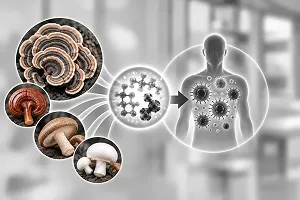
Moving From Preclinical Research to Human Evidence
Clinical research on medicinal mushrooms has moved beyond laboratory and animal experiments, but the human evidence remains uneven and varies considerably between preparations. Studies have investigated mushrooms such as Turkey Tail (Trametes/Coriolus versicolor), Reishi (Ganoderma lucidum), Shiitake, and Agaricus species, generally as complementary approaches alongside conventional cancer treatment.
Researchers have examined outcomes including survival, treatment-related side effects, immune markers, and quality of life.
Turkey Tail: One of the More Studied Examples
Turkey Tail-derived preparations, particularly PSK (polysaccharide-K), have been investigated extensively in cancer research. A 2022 Cochrane review included 7 randomized trials involving 1,569 people with colorectal cancer.
The review found low-certainty evidence suggesting a small improvement in five-year survival, while evidence regarding reductions in chemotherapy- or radiotherapy-related side effects remained very uncertain.
This is an important example of why clinical evidence needs to be interpreted carefully: a finding can be statistically interesting while still having low certainty, meaning further research could change the conclusion.
What Do Systematic Reviews Suggest?
A 2019 systematic review and meta-analysis included 23 randomized trials involving 4,246 cancer patients and evaluated preparations related to Coriolus versicolor and Ganoderma lucidum.
The analysis reported associations with lower mortality and some immune-related changes. However, the researchers described these findings as potential benefits rather than evidence establishing medicinal mushrooms as proven cancer treatments.
Systematic reviews are valuable because they bring together results from multiple studies, but their conclusions are influenced by the quality, consistency, and design of the studies included.
Why the Evidence Needs Careful Interpretation
Clinical studies can differ substantially in several important ways, including:
- Mushroom species and strain
- Extract composition and preparation
- Dose and treatment schedule
- Cancer type and stage
- Conventional chemotherapy or radiotherapy regimen
- Number of participants
- Outcomes measured
- Duration of follow-up
Because of these differences, findings from one mushroom preparation cannot automatically be applied to another. For example, evidence involving a specific PSK preparation from Turkey Tail should not automatically be interpreted as evidence for every Turkey Tail supplement or for medicinal mushrooms generally.
This variation is one reason why systematic reviews may describe some findings as promising while also emphasizing uncertainty or limitations in the evidence.
View the National Cancer Institute reference →
What Does “Complementary” Mean?
Many clinical studies investigate medicinal mushrooms alongside conventional cancer treatment, rather than as replacements for surgery, chemotherapy, radiotherapy, targeted therapy, immunotherapy, or other established treatments.
This distinction matters. A study showing a possible benefit when a mushroom-derived preparation is used alongside conventional treatment does not necessarily demonstrate that the mushroom works as a standalone cancer therapy.
The clinical question is therefore much more specific: Can a particular mushroom-derived preparation provide a measurable benefit when used in an appropriate clinical setting?
That question requires evidence from well-designed human trials.